Placozoan genomics
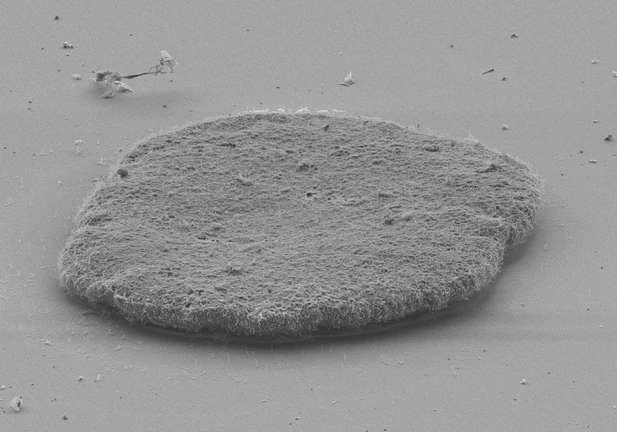
Image credit: Michael G. Hadfield, CC BY-SA 4.0, via Wikimedia Commons.
Placozoans are flat, millimeter-scale animals with no gut, no nerves, no muscle, and no front or back. They are genetically diverse and morphologically almost identical, which is why the phylum went a century with one named species.
The problem
Placozoans look almost identical to one another, so their genetic variation went unrecognized for a long time. Sequence and functional differences separate the groups clearly once you look, and one class of branched placozoans, the Polyplacotomia, falls out as a deep-branching lineage.
Their simplicity has often been read as primitiveness, and placozoans have long been among the candidates for sister to all other animals, alongside sponges and ctenophores. Where they actually sit is unsettled. The Trichoplax nuclear genome grouped them with cnidarians and bilaterians, some analyses recover Placozoa as sister to Cnidaria, and the root of the animal tree is itself contested, with recent work on ancient gene linkages favoring ctenophores.
Little is known about how they live, how they reproduce, or what they sense. What is emerging in this vein suggests more capacity than the body plan implies, and the answer connects to G protein-coupled receptors. In gorgeous work, Gaspar Jékely’s group has shown that Trichoplax expresses neuropeptides in distinct cell populations and responds to them with specific behaviors, crinkling, turning, or flattening depending on the peptide, so a nerveless animal turns out to run on peptidergic signaling. More recently they deorphanized five placozoan GPCRs that respond to monoamines, four of them sharing ancestry with bilaterian melatonin receptors, and showed the animal makes those monoamines and changes its speed and shape in response.
The approach
Sequence and annotate many placozoan genomes from distinct populations, then compare them in a phylogenomic framework and read the functional differences off the trees.
The point of doing it that way is that morphology cannot do this job here. In a classical treatment, the characters that distinguish lineages and carry the signal for evolutionary patterns are anatomical. Placozoans have few to work with. So molecular functional characters take their place: gene content, gene family expansions and losses, and what those imply about how each lineage lives.
What we found
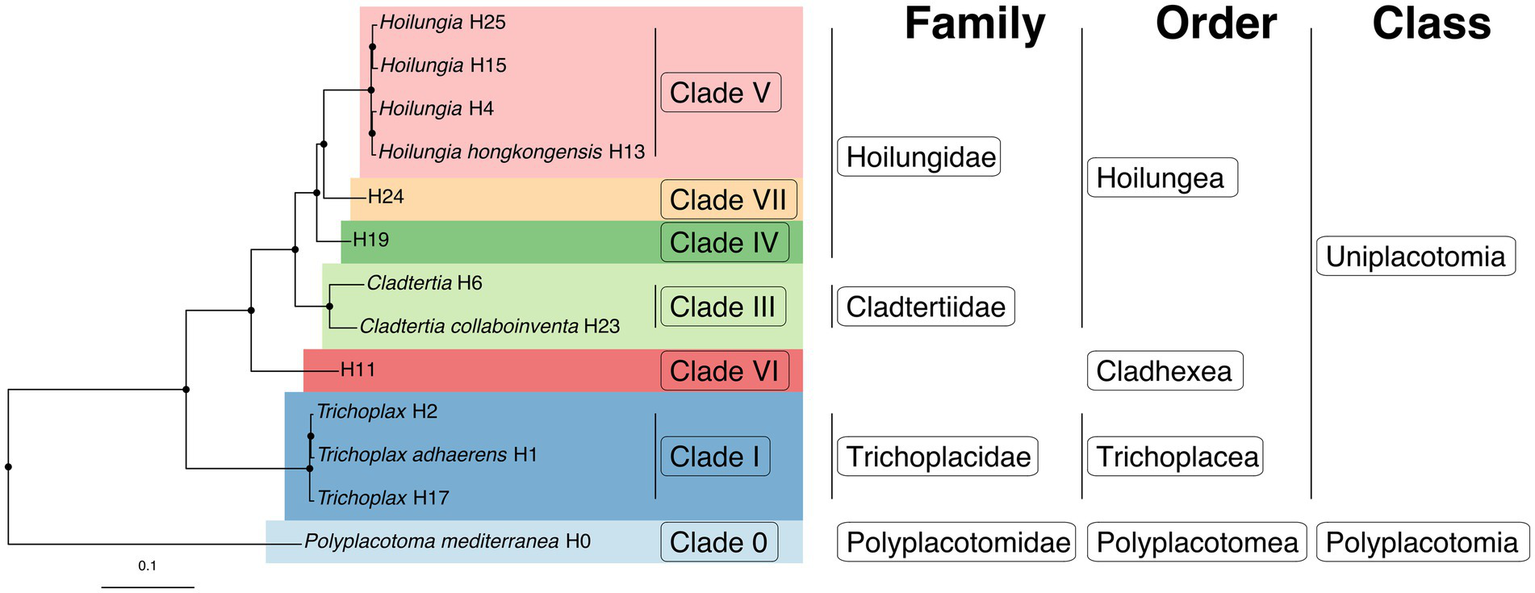
Protein sequences from seven genomes more than doubled the taxon sampling and gave the first nuclear phylogenomic reconstruction of all major placozoan lineages. That produced the first complete Linnaean classification of the phylum, more than a century after its discovery: two classes, four orders, three families, a genus, and a species.
Polyplacotoma mediterranea sits as sister to all other placozoans, a split we date at over 400 million years. Even that deep divergence sits on a long branch to other animals, which suggests a bottleneck followed by diversification.
Adding morphological data to the phylogenomic matrices moved the sister group of other animals from ctenophores to sponges, which is a live question in animal phylogeny and a striking amount of movement for a modest amount of data.
Where it stands
Current work is on transcription factors, stress responses, and sensing across the placozoan tree, and how each of those varies between lineages.
People
The placozoan work is led by Bernd Schierwater and Kai Kamm at the Institute of Animal Ecology, Stiftung Tierärztliche Hochschule Hannover, and Rob DeSalle at the American Museum of Natural History. I assemble and annotate the genomes and do genome-scale functional analyses.
Support
###Current Support
Ongoing work is not currently funded.